Stochastic Parrots and Beyond
Orientation · Normative Dimensions of Generative AI
License
These slides are licensed under CC BY 4.0. You can copy, change, and teach them if you give credit.
Source and handouts: maehr.github.io/stochastic-parrots-and-beyond
Press S for the presenter notes and ? for the keyboard shortcuts.
Our question
How can we make — and defend — a responsible decision about generative AI in our own research?
- Not a list of permitted and forbidden tools.
- A transparent position that you can explain to colleagues, reviewers, and the people your research affects.
Four lenses
- Scale and environment. What does a model cost, and where do its data come from?
- Representation and Pygmalion. Whose perspectives become normal?
- Lifecycle and labor. Who does the work, and who carries the risk?
- Political economy. Which incentives keep a practice in place?
In the afternoon, Panarchy connects the lenses to the levels where change is possible.
One lifecycle, six stages
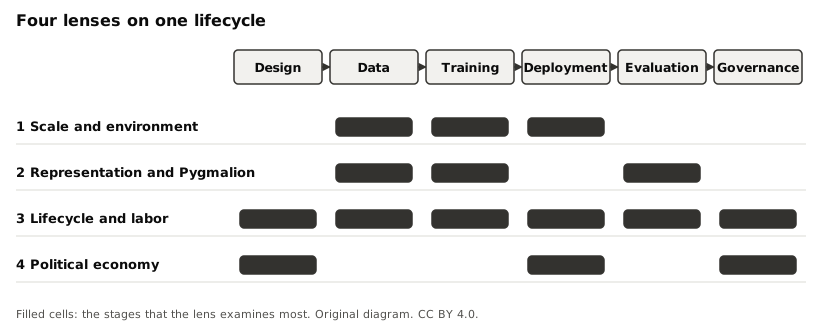
Original diagram. CC BY 4.0.
A short case
Hypothetical example
A doctoral candidate in history wants to use a hosted chatbot to summarize 200 digitized newspaper articles for a literature review.
| Lens | First question |
|---|---|
| Scale and environment | What is known about the model’s training data and energy use? |
| Representation | Whose voices does the summary make typical, and whose does it drop? |
| Lifecycle and labor | Who labeled the data, and who checks the summaries? |
| Political economy | What does the provider gain, and what does the university pay? |
This example is invented for teaching.
Concepts we use all day
- Stochastic parrot: Bender et al.’s term for a system that stitches together linguistic forms from its training data “without any reference to meaning” (2021, 617). Whether such systems understand is debated (Mitchell and Krakauer 2023).
- Documented vs. hypothetical: we mark every example. A product name is not evidence.
- Known, unknown, avoidable: three columns for every cost.
- Levels: a change in a project, a department, a university, an industry, or a law.
Activity: your research use · 7 minutes
- Alone, 2 minutes. On a card, write one actual or planned use of generative AI in your research: the task, the system, why you might use it, and what you do not know about it.
- Pairs, 5 minutes. Read your cards to each other. Add one question from a lens.
Do not write confidential or personal data on the card.
Expected output
- One card for each participant, with one research use.
- A wall of anonymous research uses that we return to in every lens.
Each lens adds one worksheet. The afternoon adds a Panarchy chart, an Ecocycle diagnosis, and your own next action.
The day
- Four lenses, one after the other.
- Integrate the lenses and agree on the Panarchy challenge.
- Panarchy: a facilitated discussion across levels.
- Ecocycle: a short adaptation to sort the priorities.
- Research-use clinic and peer review.
- Next actions and the follow-up task.
The edition page gives the times.
Sources
- Bender, Gebru, McMillan-Major, and Shmitchell (2021): On the Dangers of Stochastic Parrots.
- Mitchell and Krakauer (2023): The Debate over Understanding in AI’s Large Language Models.
- Course website: lenses, handouts, and literature.
Takeaway
We do not look for permission. We look for reasons that we can defend.
Stochastic Parrots and Beyond · Laura Wagner and Moritz Mähr · CC BY 4.0
Stochastic Parrots and Beyond · Orientation · CC BY 4.0