Lens 4: Political Economy
Power and Markets
Learning question
Which incentives preserve an unsafe or inequitable practice?
The first three lenses showed costs, harms, and hidden labor. This lens asks why they persist.
Slides: CC BY 4.0. Lesson page and worksheet: maehr.github.io/stochastic-parrots-and-beyond
1. Concentrated resources
- AI is made of models, data, labor, development frameworks, and computational power.
- A few companies control most of these resources.
- “Openness alone does not perturb the concentration of power in AI.”
Widder, Whittaker, and West (2024), Nature.
2. “Open” is a claim to check
- More than 45 generative AI systems, 14 dimensions of openness.
- Many “open” systems are “open weight” at best.
- Many providers withhold information on training and fine-tuning data.
- Openness is composite and comes in degrees.
Liesenfeld and Dingemanse (2024), FAccT.
3. Models encode the goals of their makers
- Every model simplifies the world according to the priorities of its makers (O’Neil 2016, ch. 1).
- A system optimized for engagement, market share, or a fast release can conflict with the goals of research.
4. Institutions set defaults
- Universities decide which tools to license, which to recommend, and which data may leave the institution.
- These defaults shape practice more than individual intentions.
- Procurement and policy are places of leverage, not only of compliance.
5. Regulation: the EU AI Act as one example
From 2 August 2025, providers of general-purpose AI models must, under Article 53:
- keep technical documentation,
- inform providers who build on the model,
- have a policy to comply with EU copyright law,
- publish “a sufficiently detailed summary about the content used for training”.
Free and open-source models with public weights are exempt from the first two duties, unless they have systemic risk.
Fines are possible from 2 August 2026. Models placed on the market before 2 August 2025 have until 2 August 2027.
Regulation (EU) 2024/1689, arts. 53, 101, 111(3), and 113. Not legal advice.
Case: an “open” license
Documented case
| Question | Llama 2 license (2023) | Open Source AI Definition 1.0 (2024) |
|---|---|---|
| Any purpose, without permission? | No: 700 million user threshold, use policy | Required |
| Outputs may improve other models? | Not other large language models | No such restriction |
| Weights available? | Yes, under the license | Required |
| Detailed information on training data? | Not required | Required |
Sources: Meta (2023); Open Source Initiative (2024); Maffulli (2023).
Who gains, who pays?
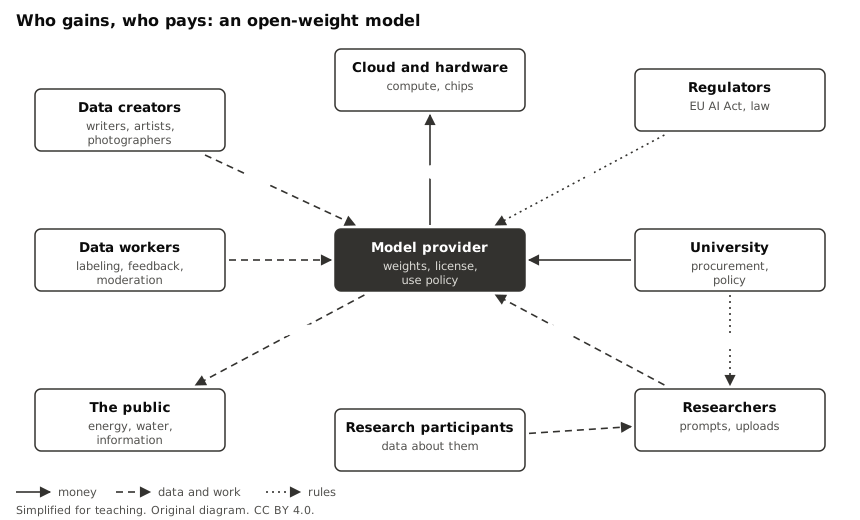
Original diagram. CC BY 4.0.
Activity · 15 minutes
Map stakeholders and incentives. Groups of three or four, on paper or on a laptop.
- Choose a research-use card from your group. Use Llama 2 only if no card fits. (3 min)
- Place the stakeholders. For each: gains, costs or risks, leverage. (7 min)
- Circle one incentive that keeps an unsafe or inequitable practice in place. (2 min)
- Write one feasible governance change: who acts, at which level, by when. (3 min)
Worksheet: Lens 4, stakeholder and incentive map
Expected output
A stakeholder and incentive map for each group:
- stakeholders with gains, costs, and leverage,
- one circled incentive,
- one feasible governance change with an actor, a level, and a date.
Sources
- Widder, West, and Whittaker (2023): Open (For Business); published version in Nature (2024).
- Liesenfeld and Dingemanse (2024): Rethinking Open Source Generative AI.
- Open Source Initiative (2024): The Open Source AI Definition 1.0.
- Regulation (EU) 2024/1689, the AI Act.
Takeaway
A practice persists when someone gains from it. Find the incentive, then find the level where it can change.
Stochastic Parrots and Beyond · Lens 4 · CC BY 4.0