Panarchy and Ecocycle
Changes across levels
License and attribution
The structures and illustrations used in this session are adapted under Creative Commons Attribution-ShareAlike 4.0 from the original work of Keith McCandless, Henri Lipmanowicz and Nancy White found at www.liberatingstructures.com and the Liberating Structures Fieldbook (2026). Licensed under CC BY-SA 4.0.
These slides are licensed under CC BY-SA 4.0. The diagrams are original drawings. The deck uses no Liberating Structures icons.
Learning question
What changes across interconnected levels would make generative AI use in academic research more responsible?
1. Levels change at different speeds
- Small, local levels change fast: a project can change next week.
- Large levels change slowly: a university, an industry, or a law changes over years.
- Panarchy helps a group “identify opportunities and obstacles for spreading ideas at multiple levels”.
Liberating Structures, Panarchy; Holling (2001) on the adaptive cycle.
2. Influence runs both ways
- Ideas and experiments can spread upwards.
- Resources, rules, and memory flow downwards.
- A fast level often waits for a slow one. A slow level often ignores a fast one.
3. Discover your own levels
An illustration, not a template:
individual research project → research group or department → university and research sector → model vendors and industry → regulation and society
The Panarchy chart
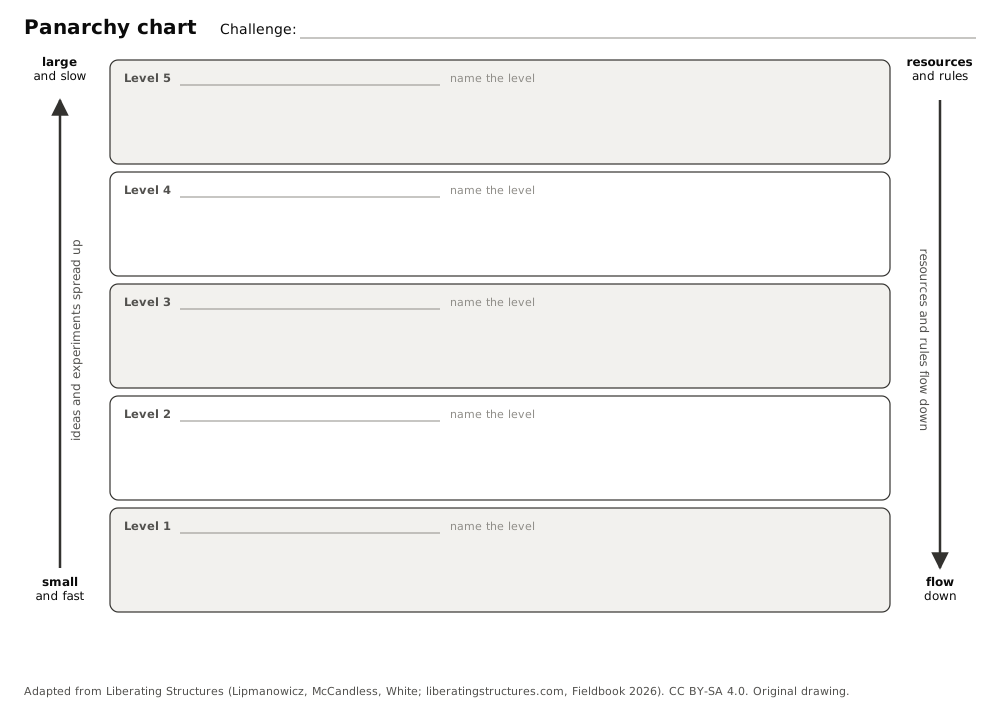
Original diagram, adapted from Liberating Structures Panarchy. CC BY-SA 4.0.
A short case
Hypothetical example
A department wants researchers to disclose their use of generative AI.
- Project level: researchers have no template and do not know what to write.
- Department level: a template would take one afternoon, but nobody owns it.
- University level: the licensed chatbot has no documented training data, so a disclosure stays vague.
- Vendor level: the vendor gains from vagueness.
Leverage: the department writes the template (fast), and asks the university to add documentation to the next procurement (slow).
This example is invented for teaching.
Panarchy: 120 minutes and a break
| Steps | Minutes | What happens |
|---|---|---|
| 1 | 5 | Frame the challenge |
| 2–5 | 35 | Identify influences, sort them into levels, compare, build one chart |
| 6–7 | 25 | Diagnose neglected levels and uneven resources, share diagnoses |
| 8 | 30 | Afternoon break |
| 9–10 | 25 | Find opportunities and barriers across levels, share them |
| 11–12 | 25 | Vote for three priorities, commit to actions with 1-2-4-All |
| 13 | 5 | Arrange the follow-up |
The durations of the working steps follow Liberating Structures. Step labels adapted.
1-2-4-All
- 1 minute alone: what can I do in the next month?
- 2 minutes in pairs: share and sharpen.
- 4 minutes in fours: find actions that fit together, and allies across levels.
- All: each group shares its strongest action.
Ecocycle: a 30-minute adaptation
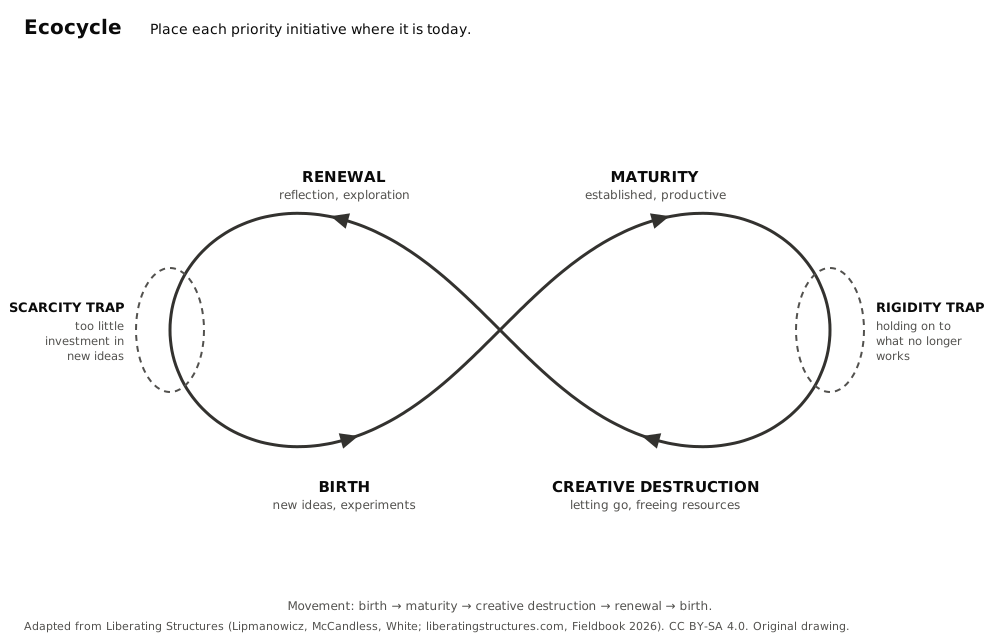
The full Ecocycle Planning takes about 90 minutes. This is a shortened adaptation. Original diagram, CC BY-SA 4.0.
Phases and traps
| Phase or trap | Meaning |
|---|---|
| Birth | A new idea or experiment |
| Maturity | An established, productive practice |
| Creative destruction | Letting go, which frees resources |
| Renewal | Reflection and exploration before the next birth |
| Rigidity trap | Holding on to a practice that no longer works |
| Scarcity trap | Not investing enough in new ideas |
Activity: Ecocycle · 30 minutes
- Hear the four phases. (5 min)
- Place the priority initiatives on the Ecocycle. (5 min)
- Find the initiatives in the scarcity trap and in the rigidity trap. (10 min)
- Propose a move for each trapped initiative. (5 min)
- Record concrete next steps on the action plan. (5 min)
Expected output
- A shared Panarchy chart with levels and annotations.
- Three priorities, with action owners and a review point.
- An Ecocycle diagnosis with the traps and the proposed moves.
- Your own next action on the action plan.
Sources
- Liberating Structures: Panarchy and Ecocycle Planning.
- McCandless and White (2026): The Liberating Structures Fieldbook.
- Holling (2001): Understanding the Complexity of Economic, Ecological, and Social Systems.
Takeaway
Responsible use is not only a personal choice. Find the level where a change is feasible, and the allies at the levels above and below.
Slides: CC BY-SA 4.0, adapted from Liberating Structures.
Stochastic Parrots and Beyond · Panarchy and Ecocycle · CC BY-SA 4.0 · adapted from Liberating Structures