Lens 3: Lifecycle and Labor
Materiality and Extraction
Laura Wagner and Moritz Mähr
Learning question
Who does the work, carries the risk, or has no recourse?
Content note: the case describes workers who read texts about violence and sexual abuse. We quote none of the texts.
1. Six stages of the lifecycle
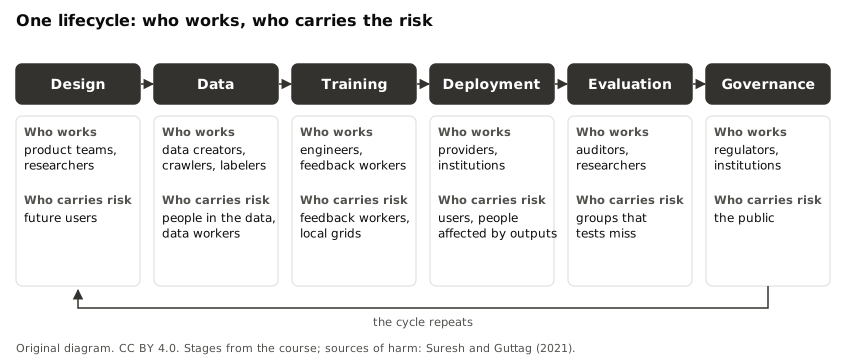
Original diagram. CC BY 4.0. Harm can enter at every stage (Suresh and Guttag 2021).
2. Labor behind “automation”
- Ghost work: task-based, on-demand work that keeps services running and stays invisible (Gray and Suri 2019).
- Fauxtomation: presenting human work as automated. It “aims to disguise the real character of the work in question” (Taylor 2018).
- Feedback work: for InstructGPT, about 40 contractors wrote example answers and ranked outputs (Ouyang et al. 2022).
- Instructions shape data: instructions and metrics reproduce the worldview of the requesters (Miceli and Posada 2022).
3. Extraction and consent
- Training data come from writers, artists, photographers, and translators.
- Their consent was rarely asked.
- Crawford treats data collection at this scale as extraction, next to minerals and labor (Crawford 2021, chs. 2–3).
4. Recourse is uneven
Undocumented training data “perpetuates harm without recourse.”
Bender et al. (2021), 615.
- A person harmed by an output can rarely find out which data or decision caused it.
- A worker harmed by the work is often employed by a supplier, not by the provider.
Case: safety labeling in Kenya
Documented case
| Item | Reported fact |
|---|---|
| Task | Label passages about violence, hate speech, and sexual abuse, for a ChatGPT safety detector |
| Supplier | Sama, outsourcing firm, team in Nairobi |
| Take-home wage | About USD 1.32 to 2 per hour |
| Workload | 150 to 250 passages per nine-hour shift, according to workers. Sama said 70. |
| Impact | All four employees interviewed “described being mentally scarred by the work” |
| End | Sama ended the work in February 2022, eight months early |
Perrigo (2023), TIME.
Activity · 15 minutes
Build a lifecycle risk matrix. Groups of three or four, on paper or on a laptop.
- Choose a research-use card from your group. Use ChatGPT only if no card fits. (3 min)
- For each of the six stages: who works, who carries the risk, who has recourse? (7 min)
- Mark the stage of highest risk and the stage where you have most influence. (2 min)
- Write one intervention for your stage. (3 min)
Worksheet: Lens 3, lifecycle risk matrix
Expected output
A lifecycle risk matrix for each group:
- for each stage: who works, who carries the risk, who has recourse,
- the stage of highest risk and the stage of most influence,
- one intervention.
Sources
- Perrigo (2023): OpenAI Used Kenyan Workers on Less Than $2 Per Hour, TIME.
- Taylor (2018): The Automation Charade, Logic(s).
- Suresh and Guttag (2021): Sources of Harm throughout the ML Life Cycle.
- Crawford (2021): Atlas of AI, chapters 2 and 3.
Takeaway
“Automatic” often means “someone else’s work”. Find the people at each stage, and ask who can object.
Stochastic Parrots and Beyond · Lens 3 · CC BY 4.0