Lens 4: Political Economy — Power and Markets
Which incentives preserve an unsafe or inequitable practice?
- Slot: about 35 minutes in the morning, with a 15-minute group activity.
- Output: a stakeholder and incentive map.
- Worksheet: Lens 4 worksheet: stakeholder and incentive map.
- Slides: Lens 4 slide deck.
- Anchor sources: Widder, West, and Whittaker (2023); Regulation (EU) 2024/1689, the AI Act (European Parliament and Council of the European Union 2024).
Question
Which incentives preserve an unsafe or inequitable practice?
The first three lenses show costs, harms, and hidden labor. This lens asks why these patterns persist. It follows money, infrastructure, and rules. It also asks where a university or a research group has leverage of its own.
Core concepts
1. Generative AI depends on concentrated resources
Widder, Whittaker, and West analyze what AI is made of: models, data, labor, development frameworks, and computational power (2024). A few companies control most of these resources. The authors find that “openness alone does not perturb the concentration of power in AI” (Widder et al. 2024). Claims about “open” AI can even “exacerbate rather than reduce concentration of power in the AI sector” (Widder et al. 2024).
2. “Open” is a claim to check, not a property to assume
Liesenfeld and Dingemanse assess more than 45 generative AI systems along 14 dimensions of openness, from training data to documentation and licensing. Many systems that are called open are “open weight” at best. Many providers withhold information about training and fine-tuning data (Liesenfeld and Dingemanse 2024). Openness is therefore composite and comes in degrees. One feature, such as downloadable weights, does not make a system open (Liesenfeld and Dingemanse 2024).
3. Models encode the goals of their makers
O’Neil shows how models simplify the world according to the priorities of the people who build them, and how these priorities stay hidden behind numbers (2016, ch. 1). A system that is optimized for engagement, for market share, or for a fast release can be at odds with the goals of research.
4. Institutions set defaults through procurement and policy
Universities choose which tools to license, which to recommend, and which data may leave the institution. These choices shape what individual researchers do, often more than individual intentions. Procurement and policy are therefore places of leverage, not only of compliance.
5. Regulation is one lever among several
The EU AI Act is one example of governance. The duties of its Article 53 for providers of general-purpose AI models in the EU apply from 2 August 2025 (European Parliament and Council of the European Union 2024):
- keep technical documentation of the model,
- give information to providers who build systems on the model,
- put in place a policy to comply with EU copyright law,
- publish “a sufficiently detailed summary about the content used for training”.
Models under a free and open-source license with public weights are exempt from the first two duties, but not from the copyright policy or the training summary. The exemption does not apply to models with systemic risk (European Parliament and Council of the European Union 2024, art. 53(2)).
The duties phase in. The Commission can fine providers from 2 August 2026. Providers of models placed on the market before 2 August 2025 have until 2 August 2027 to comply (European Parliament and Council of the European Union 2024, arts. 101, 111(3), 113).
This page summarizes the regulation for teaching. It does not say whether the AI Act applies to a specific project in Switzerland or elsewhere. Ask the legal service of your institution.
Evidence and limits
- The concentration of resources and the uses of the word “open” are documented in peer-reviewed analyses (Widder et al. 2024; Liesenfeld and Dingemanse 2024).
- The license terms in the case are public documents (Meta 2023; Open Source Initiative 2024).
- The duties of the AI Act are law. Their enforcement and interpretation are still developing.
- Market shares and investment figures change fast. Check the date of any figure.
- Incentives are inferred from structures and statements. A company rarely states them.
- The AI Act is subject to amendments and implementing guidance. Check the current consolidated text before you rely on a date or an article.
Case: an “open” license
This case compares two public documents: the license of Llama 2 and the Open Source AI Definition.
In July 2023, Meta released Llama 2 and described it as open. Its license permits download and many uses, with conditions (Meta 2023):
- A company whose products had “greater than 700 million monthly active users” at the release date needs a separate license from Meta.
- Users must not use the model or its outputs “to improve any other large language model”, except Llama 2 and its derivatives.
- Every use must follow Meta’s Acceptable Use Policy.
The Open Source Initiative stated that the license is not open source. It restricts commercial use for some users and restricts fields of use (Maffulli 2023). In October 2024, the OSI published the Open Source AI Definition 1.0 (Open Source Initiative 2024). It requires the freedom to use a system “for any purpose and without having to ask for permission”, and the freedoms to study, modify, and share it. It also requires access to the code, the parameters, and “sufficiently detailed information about the data used to train the system” (Open Source Initiative 2024).
| Question | Llama 2 license | Open Source AI Definition 1.0 |
|---|---|---|
| Can anyone use it for any purpose? | No: user threshold and use policy | Required |
| Can its outputs improve other models? | Not other large language models | No such restriction |
| Are the weights available? | Yes, under the license | Required |
| Is detailed information about training data required? | Not by the license | Required |
Why this case. The word “open” carries reputation, and in the EU it can reduce regulatory duties. Liesenfeld and Dingemanse call the use of the word without the substance “open-washing” (2024). For a researcher, the question is practical: can I inspect, document, and cite what I use?
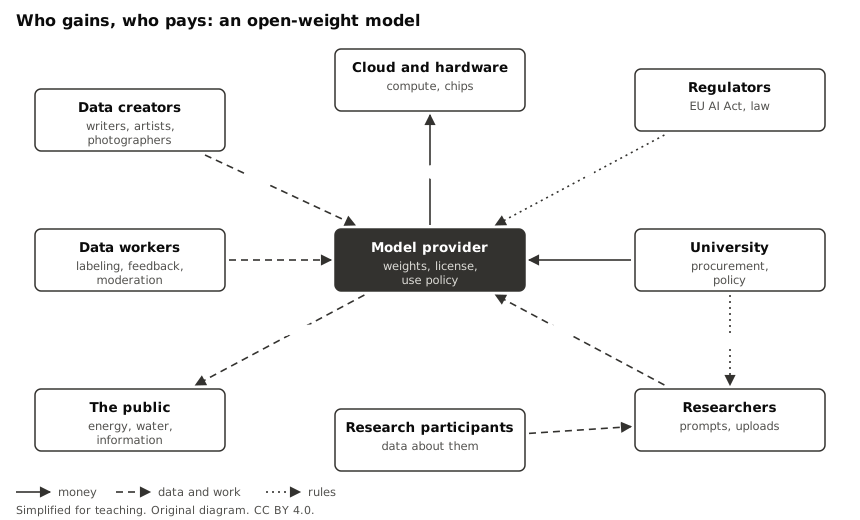
Activity
Map stakeholders and incentives. Work in groups of three or four, for 15 minutes, on paper or on a laptop.
- Choose the system. First choice: the system from one research-use description in your group. Use Llama 2 as in the ready-made case only when no description fits. (3 minutes)
- On the worksheet, place the stakeholders. For each, note what it gains, what it pays or risks, and which leverage it has. (7 minutes)
- Circle one incentive that keeps an unsafe or inequitable practice in place. (2 minutes)
- Write one feasible governance change: who must act, at which level, and by when. (3 minutes)
This is the first choice. A use from your own research makes the analysis concrete.
- Choose the research-use description with the most open questions.
- Its author explains the use in two minutes: the task, the system, and what they do not know about it.
- Describe the use, not the data. Do not show confidential, personal, or unpublished research data.
- Place your own university on the map: as a licensee, a data owner, or a rule maker.
Use the Llama 2 license when no description in your group fits, or when the group prefers not to discuss its own use. The case shows how a license distributes gains, costs, and leverage.
A faculty licenses one chatbot for all staff because the vendor offers a discount. The map shows: the vendor gains data and lock-in. The faculty gains convenience, and researchers lose the choice of a documented model. A feasible change: the faculty adds a documentation requirement to the next procurement, and the research data office maintains a list of documented alternatives. This example is invented for teaching.
Output
A stakeholder and incentive map on one sheet for each group. It shows the stakeholders with their gains, costs, and leverage. It circles one incentive that preserves an unsafe or inequitable practice, and it names one feasible governance change.
Reading
- Required: Bender et al. (2021), section 7, “Paths Forward”.
- Recommended: Widder, West, and Whittaker (2023), or its published version in Nature (Widder et al. 2024); O’Neil (2016), introduction and chapter 1.
- For the case: Liesenfeld and Dingemanse (2024); the Open Source AI Definition (Open Source Initiative 2024); Article 53 of the AI Act (European Parliament and Council of the European Union 2024).
Slides
Open the Lens 4 slide deck. Press S for the presenter notes.
Timing (35 minutes). Input on the core concepts, 10 minutes. The case, 5 minutes. Activity, 15 minutes. Plenary round, 5 minutes.
Prompts.
- “Who pays for the tool that your institution provides, and with what?”
- “What would change if your university bought only documented models?”
- “Which incentive would you need to change to make your own practice more responsible?”
Link to the afternoon. The governance changes from this activity are the first material for Panarchy. Collect them on the wall. Ask the group to agree on the Panarchy challenge in the next block.
Difficult moments. Discussions of regulation can turn into legal questions about a specific project. Note the question for the legal service of the institution, and return to incentives and levers.
Fallback. Start with the group’s own example. If no description fits, use the case. Groups that finish early can add a second map for the same system ten years ago, and compare the stakeholders.